
If you've ever said 'I'm so stressed I think I'm having anxiety and I'm probably burnt out' — same. The words overlap. But they describe different states, and the response to each looks different.
Most people figure this out only after struggling for a while. Naming it accurately is the first relief.
Stress
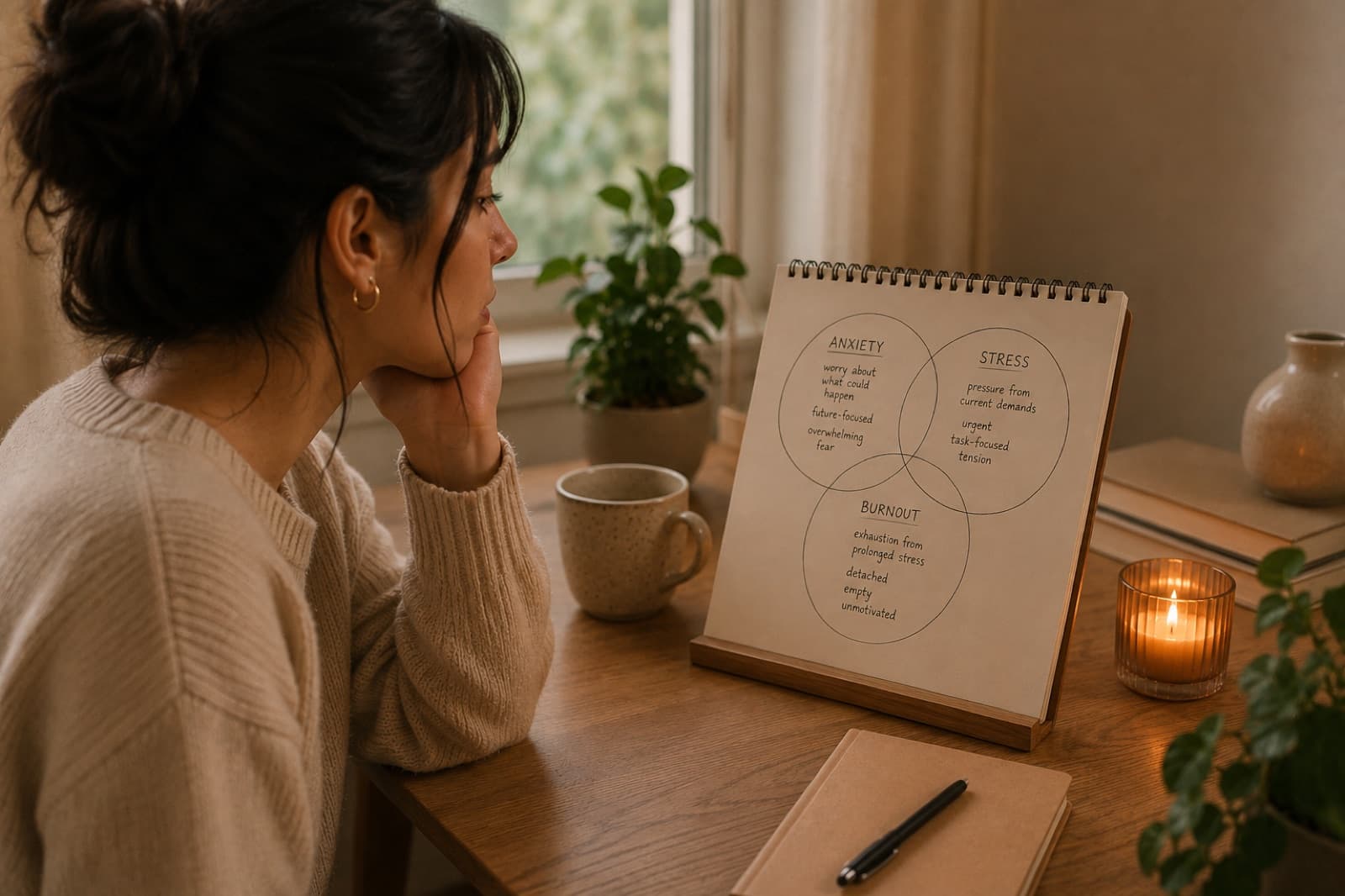
Stress is a response to something specific — a deadline, a presentation, a difficult conversation. The body activates, you push through, and once the trigger passes, you usually settle.
Stress is not bad in itself. Healthy stress is what gets you to the meeting on time. The problem is when it doesn't get to switch off.
Anxiety
Anxiety is what happens when the body's stress response stays on without a clear, present trigger. You feel braced for something — but you can't always say what.
It often shows up as overthinking, restlessness, racing thoughts, gut issues, or a tightness in the chest that arrives even on good days.
Burnout
Burnout is what happens when chronic stress and unmet rest meet over time. The body stops mounting the response — instead of feeling 'on', you feel flat.
Burnout's signature is depletion, not activation. Where anxiety is too much, burnout is too little.
Why the distinction matters
Stress responds to changing the situation.
Anxiety responds to working with the nervous system — slower breath, less caffeine, real conversation.
Burnout responds to recovery — actual rest, smaller load, often, change of role.
Treating one as another is what leaves people feeling stuck.
A small thing to try this week
Each evening, write one word for how the day felt — 'on', 'braced', or 'flat'. After a week, look at the pattern. That single word will usually tell you, with surprising accuracy, which of the three you're navigating.
When it might be worth talking to a psychologist
If 'flat' shows up more than three times in a week, or 'braced' is the default rather than the exception, a single conversation can help you sort it out and decide what to do next.